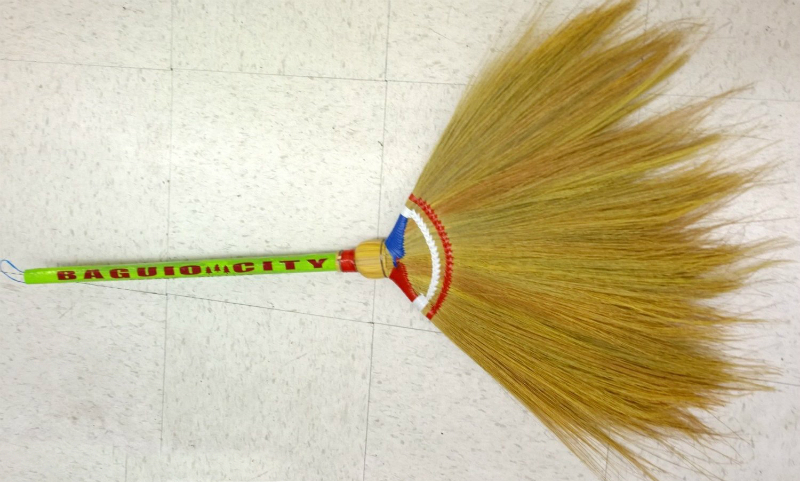
There are two words in the dictionary that can serve as translations for the English “broom.”
The simple noun that is widely used is walis.
Up until a few decades ago, the word pamalis (pangwalis) was also common, and if you use it today, it can still be understood, because it is a conjugation of the verb walis and it literally means “something used for sweeping.”
Brooms of the Philippines
There are two main types of native brooms used in the Philippines — the walis tingting for outdoors and the walis tambo for smooth floors indoors and perhaps on the patio.
Walis-tingting is a broom made from the thin midribs of palm leaves. The stiff ribs are tied up on one end. It is usually paired with a simply constructed dustpan, as you can see in the picture. The can used for the dustpan is usually a cutout of an aluminum can of cooking oil.

walis tingting at daspan
broom and “dustpan”