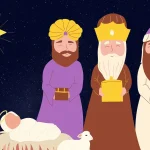
The Philippines has the longest Christmas season in the world. Twenty days of celebration, beginning on December 16 and ending on January 6, recall the birth of Christ. The many days of Christmas belong to the rich tradition of the Philippines as the only Christian country in Asia.
The nine days before Christmas are days of happy waiting. Christmas Eve and Christmas Day are strung together, the most joyous days of the season. On January 1, when the New Year is welcomed, Catholics also honor the motherhood of Our Lady. Finally, on January 6, the Christmas season closes with the Epiphany, when the three Magi came with gifts to the Christ Child. Tradition says that if Christmas Day is for giving gifts to children, the Epiphany is for giving gifts to older people. On this day, older people call on their relatives and close friends to pay respects and wish them well.
To know the joyful rituals of Christmas is to cherish them.
The Misa de gallo, the “Mass at cockcrow,” which is held each day nine days before Christmas, was timed to allow the farmers to attend church early enough before going to their chores. Today, even in the cities, the Masses are still said at dawn. Many people offer the little sacrifice of getting up early to the Christ Child. Others simply enjoy being up while the morning is nippy.
Hanging the star-shaped paper lantern, called parol, is another cherished ritual. No one remembers how it all began. A story says that the lantern stands for the star of Bethlehem which led the Magi to the Christ Child. Another story says that the lantern is to show Mary and Joseph the way to the manger where the Christ Child is to be born.
In the churches, at the doorways and windows of homes, in the stores and along roadways, the parol hangs at Christmastime in every barrio, town and city. Sometimes the lanterns are made at home out of shaped bamboo sticks and transparent tissue paper. Quite often, schoolchildren make lanterns as their special Christmas art work. Today, more and more lanterns are made by experts who swiftly shape and paste as many as ten a day. The little town of Las Piñas just outside Manila is famous for its Christmas lantern-makers. As early as the first days of December, the main street of Las Piñas is lined and festooned with bright lanterns for sale. Along the streets of many towns and cities walk the lantern peddlers with their frail bright wares swinging from bamboo poles. A Filipino home is not complete without a lighted lantern at Christmastime.
The lilting Christmas carols, called villancicos, are the ritual sounds of Christmas. They were sung many years ago in Europe and were brought to the Philippines by the Spanish missionaries. With tambourines and castanets, the villancicos are cheery lullabies for the Christ Child. Church choirs sing them at the dawn Masses and during the Midnight Mass. A memory of tambourines and castanets wafting through the sleepy haze of Midnight Mass is treasured from childhood.
In some towns in the Philippines, carolers who sing the villancicos are called pastores — in memory of the shepherds who first heard from angels the wondrous news of the birth of Christ. Strumming guitars and clicking castanets, the singers make the rounds from house to house in the hours just past suppertime and deep into the night, beginning with the first day of Misa de gallo and into New Year’s Eve. Many of the villancicos are in the dialect, lilting in melodies of the folk.
In some towns the people fulfill the ritual of Panunuluyan.
In Mexico, from which the ritual must have come to the Philippines, they call it Las Posadas. On Christmas Eve a small procession follows a couple who act the parts of Mary and Joseph. By torch and candlelight, they go about the town, recalling the evening in Bethlehem when Mary and Joseph searched for a place to stay.
Of the lovely rituals of Christmas, the most endearing is Pahalik, the kissing of the image of the Christ Child. In every Philippine church at Christmastime, there is a creche, or belen, as the Christmas scene is called. Sometimes, the creche depicts the entire hillside of Bethlehem. There are houses and roadways, shepherds with their flock, peasants in the fields, townspeople at their chores. There are angels hovering over the manger where Mary and Joseph adore the Holy Infant.
At the Gloria of the Midnight Mass, a small curtain lifts from the manger in the creche. So is revealed the Christ Child.
Many churches treasure an image of the Holy Infant. This image is brought out only during Christmas. Sometimes the statue had been made in Europe and was brought many years ago by the Spanish missionaries. Sometimes the statue is made of ivory, so old that it has yellowed beautifully. Almost every image is of a sweet Babe, his hands clasped as if in prayer. Sometimes the right hand is raised in blessing. In some parishes the Babe is clothed in velvet. In other churches he is scarcelv clothed to remind the people that Christ was poor.
At the close of Midnight Mass, while villancicos ring out, the priest takes the Holy Infant from the creche to be kissed by the people. He stands at the foot of the altar while the people come forward. Quite often there is a long, long line of people who come to kiss the Christ Child. Once in a while the priest wipes the image with a perfumed cloth. The lovely scent lingers as another delightful memory of Christmas.
On the morning of Christmas Day, in some parishes the image of the Christ Child is brought to the homes. Laid on a satin cushion and shielded with a linen cloth from the sun, the Holy Infant is carried by red-robed sacristans from house to house. They ring a little bell as they walk down the streets, announcing that the Christ Child is passing by. With great excitement the children listen to the bell as it comes nearer and nearer to their homes.
In Catholic homes the Holy Infant is received with honor. As the sacristans enter, every member of the family is at the doorway. Led by the eldest member of the family — sometimes the grandmother, more often the father — each one kisses the image. Babies are hoisted to kiss the Holy Infant, too, and servants are called to pay their respects. Very quickly the visit of the Christ Child is over. The head of the family slips a small donation on the platter that the sacristans carry. The little bell tinkles as the Christ Child crosses the threshold and goes out to the streets once more.