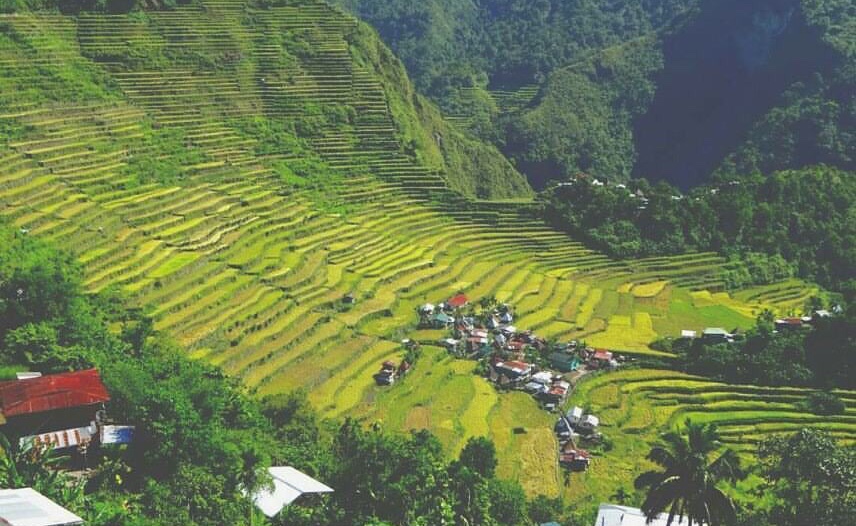
The Ifugao are the most well known of the people who live in the mountain provinces of Northern Luzon. Long ago their ancestors built the rice terraces. Covering many kilometers of mountain sides, the terraces-when they were first seen by outsidersamazed the world. Not only were they so carefully made, they were probably the best way to plant on steep mountain sides.
Until today the Ifugao plant rice and camote on the ancient terraces. Each day they take good care of the terraces. If there are broken banks, they mend them right away with mud and stones. If there are mountain slopes that are idle, they build new
terraces. Not only are the Ifugao rice terraces very old, they also are ever new.
The terraces look like .giant steps up the sides of the mountains. In some places, the Ifugao have circled mountains a thousand feet and even more in height with rows of terraces, each terrace going completely around the mountain. Even more remarkably, each row is at even level with other rows for as great a distance as half a mile around a hillside.
As much hard work went into the building of the rice terraces as inborn Ifugao wisdom. First the terrace was dug out from the hillside and strengthened by a stone wall. The back of the stone wall was filled with broken stones from the hillsides.
As the foundation of the terrace, the Ifugao placed gravel and sand and over that, some sticky clay to make it waterproof, then some gravel and sand again. The materials for the terrace came from faraway places-usually from riverbeds many miles away or from distant hilltops. Cleverly, the Ifugao used water to carry the heavier materials, allowing the river currents to bring the stones, the gravel and the sand.
Wisely, too, the Ifugao did not build the terraces out of river stones if the rivers were far away. Instead, they used the rough broken stones of the mountain sides. Later, the winds and
the rains eroded the stones away, one by one, bit by bit. Only then did the Ifugao replace them with the sturdier river stones, brought up from afar, one by one. They did this, month after month, year after year, generation after generation, until the entire wall was made of hard river stone. To this day the Ifugao maintain their terraces with precision and unwritten wisdom, earning over and over again the tribute that they are among the world’s best engineers.
The Ifugao are also known for their many myths and legends and for the traditional beliefs they love and strictly follow. These beliefs shape their day-to-day lives as well as feasts and other memorable occasions. The Ifugao have rites and rituals for every part of their lives, many ways of doing things that are dictated by their very ancient set of beliefs.
The Ifugao believe that a host of spirits lives in all five regions of the universe: in the skyworld and in the underworld, in the upstream region and in the downstream region, and throughout the known earth. No one spirit is the greatest of all, but the skyworld is the home of the most important spirits. The Ifugao render the greatest respect to the Spirit of Life, the Spirits of War, and the Spirit of Growing Things.
In their myths the Ifugao call the sun the Speaker. The bravest warriors are victorious only if they are possessed by the sun at the moment of battle. But the sun at its zenith is considered dangerous, and so all battles must cease at noon. The moon is called blood-drainer. The stars, the clouds, the lightning and the rainbow are all children of the sun or the moon.
Birth, growing up, courtship, marriage, victory or deatheach of these events is marked by ritual based on Ifugao belief. One of the most famous Ifugao rituals is called Hagabi-a celebration for good fortune. The hagabi is actually a large bench carved out of a single tree trunk. That bench stands at the front yard of almost every important Ifugao’s home-and only the important Ifugao may have a hagabi. As a ritual, Hagabi is the time when Ifugao men search for the perfect tree to make into a bench. Hagabi is both waiting for and welcoming that tree, a time for feasting.
Only the very rich Ifugao can give a Hagabi. The entire village takes part, and no one really knows how long a Hagabi will last. It depends on how long it takes the Ifugao braves to find the tree, cut and hew it and bring it back to the village.
To the sound of gongs, the braves set off for the forest.
They look for a hardwood tree, long and wide enough to be made into a bench without joints. Once they find the tree, they cut it and right there begin to carve the bench in rough form. The center is scooped out, the two ends are shaped into ferocious animal heads.
When the work is done, word is sent to the village and to houses along the way. The hagabi is found, the hagabi passes. Every household along the way prepares food for the carriers.
If the men make their way directly from the forest to the village, they would not take very long. However, they like to linger along the way, enjoying the food and drink readied for them.
Sometimes as many as thirty braves carry a hagabi. The trunk is tied with vines to a pole. Each end of the pole is carried on the shoulders of several men. The hagabi also rests on many shorter poles, which are held by the carriers. Crying in rhythm, “He, he, he,” the carriers move on. But it is not all hard work. The carriers also like to joke and play. They swing the hagabi to and fro. Sometimes a carrier hangs to the pole, adding weight instead of lifting. Another follows him and still another, amid laughter.
When the hagabi carriers are at the edge of the village, the host brings out a basket of cooked sticky rice. Everyone takes a small handful and pelts the carriers.
At last the hagabi arrives. The host jumps on the trunk while it is still held by the carriers. He announces that at last he is as rich, as important, as worthy of respect as his ancestors. In welcoming the hagabi to his house, he prays that it may bring only good fortune, health, wealth and prestige.
Now the people begin to feast in earnest. A carabao is butchered as a sacrificial offering, but many other animals have earlier been slaughtered for the feast. There is new rice and the cup of rice wine passes briskly among the braves and the elders.
The festival ends at sunset. The people of the village return to their homes. Alone with the hagabi, the new owner begins to carve in finer detail the two animal heads. He polishes the length of the hagabi, bringing out the lovely wood grain. With his hands he does the work, lavishing care on the hagabi. Because of the prestige he now enjoys as a hagabi owner, he can sit at the village council, his opinion is asked and considered, his name is invoked and reckoned with, his memory even now assured of mention and respect.
MGA KAHULUGAN SA TAGALOG
hagábi: marangyang bangkong ipinagkakaloob sa Kadangyan
hagábi: mahabàng upúan na inukit sa kahoy